

Purdue University Press provides quality resources in several key subject areas, including business, technology, health, veterinary sciences, and other selected disciplines in the humanities and sciences. As well as publishing around 25 books a year, and three subscription-based journals, the Press is committed to broadening access to scholarly information using digital technology. As part of this initiative, the Press distributes a number of Open Access electronic-only journals.
This series contains the Open Access records of some books published through Purdue University Press.

























































-

150 Years of Purdue Engineering: Celebrating Our Consequential Impact on the World
Arvind Raman and Jim Small
Since its founding 150 years ago, Purdue University’s College of Engineering has profoundly shaped and improved the world, amassing breakthroughs spanning nearly all facets of society. Highlighting the indomitable spirit, ingenuity, and achievements of more than 100 Boilermaker alumni and faculty members, 150 Years of Purdue Engineering describes the program’s journey to become one of the most consequential engineering colleges in the United States. Richly illustrated with archival and contemporary images, this book includes stories that focus on Purdue innovators who have created everything from the barcode and the electronic TV receiver to the soft-serve ice cream machine and artificial kidney. It also shares the story of “John” Mohammed M. Atalla, the co-inventor of the MOSFET, the most produced and used digital circuits in circulation today. Indeed, a Purdue alumnus played a key role in the development of the most replicated engineered device in human history. Other Boilermakers featured include Neil Armstrong, the first human to step foot on the moon; Charles Alton Ellis, a lead designer of the Golden Gate Bridge; and Amelia Earhart, the first woman to fly solo across the Atlantic Ocean. While celebrating the past, 150 Years of Purdue Engineering also provides a glimpse into the next century and a half as the university continues to cultivate talent, promote research, and share its engineering acumen with the state of Indiana and the world.
-

Academic E-Books: Publishers, Librarians, and Users
Suzanne M. Ward, Robert S. Freeman, and Judith M. Nixon
Academic E-Books: Publishers, Librarians, and Users provides readers with a view of the changing and emerging roles of electronic books in higher education. The three main sections contain contributions by experts in the publisher/vendor arena, as well as by librarians who report on both the challenges of offering and managing e-books and on the issues surrounding patron use of e-books. The case study section offers perspectives from seven different sizes and types of libraries whose librarians describe innovative and thought-provoking projects involving e-books.
Read about perspectives on e-books from organizations as diverse as a commercial publisher and an association press. Learn about the viewpoint of a jobber. Find out about the e-book challenges facing librarians, such as the quest to control costs in the patron-driven acquisitions (PDA) model, how to solve the dilemma of resource sharing with e-books, and how to manage PDA in the consortial environment. See what patron use of e-books reveals about reading habits and disciplinary differences.
Finally, in the case study section, discover how to promote scholarly e-books, how to manage an e-reader checkout program, and how one library replaced most of its print collection with e-books. These and other examples illustrate how innovative librarians use e-books to enhance users’ experiences with scholarly works.
-
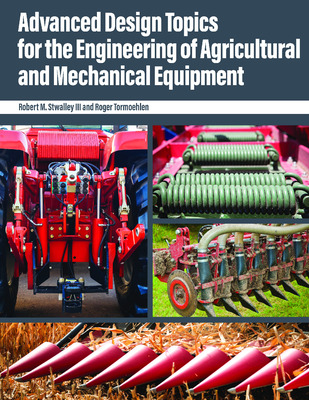
Advanced Design Topics for the Engineering of Agricultural and Mechanical Equipment
Robert M. Stwalley III and Roger Tormoehlen
Off-road equipment designs contend with some unusual challenges and environmental conditions that are not seen by standard on-road vehicles. Advanced Design Topics for the Engineering of Agricultural and Mechanical Equipment offers design topic reviews related to areas that need special consideration within off-road applications. CAN-BUS systems, soil compaction, composite bearings, field welding practices, and weld strength in bending applications are examined, among other subjects. Providing comprehensive coverage of these matters with the current state-of-the-art technologies and best practices as they relate to equipment design for the agricultural, construction, forestry, and mining industries, this book is well-aligned with collegiate advanced agricultural equipment engineering design classes at the senior or graduate level.
-

Advances in Research Using the C-SPAN Archives
Robert X. Browning
This book is a guide to the latest research using the C-SPAN Archives. In this book, nine authors present original work using the video archives to study presidential debates, public opinion and Congress, analysis of the Violence Against Women Act and the Great Lakes freshwater legislation, as well as President Clinton’s grand jury testimony. The C-SPAN Archives contain over 220,000 hours of first run digital video of the nation’s public affairs record. These and other essays serve as guides for scholars who want to explore the research potential of this robust public policy and communications resource.
-
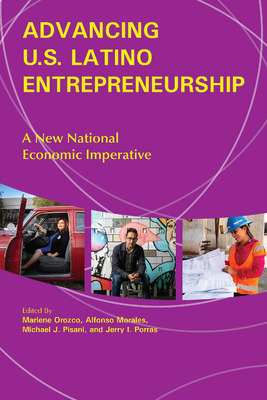
Advancing U.S. Latino Entrepreneurship: A New National Economic Imperative
Marlene Orozco, Alfonso Morales, Michael J. Pisani, and Jerry I. Porras
Advancing U.S. Latino Entrepreneurship examines business formation and success among Latinos by identifying arrangements that enhance entrepreneurship and by understanding the sociopolitical contexts that shape entrepreneurial trajectories. While it is well known that Latinos make up one of the largest and fastest growing populations in the U.S., Latino-owned businesses are now outpacing this population growth and the startup business growth of all other demographic groups in the country.
The institutional arrangements shaping business formation are no level playing field. Minority entrepreneurs face racism and sexism, but structural barriers are not the only obstacles that matter; there are agentic barriers and coethnics present challenges as well as support to each other. Yet minorities engage in business formation, and in doing so, change institutional arrangements by transforming the attitudes of society and the practices of policymakers. The economic future of the country is tied to the prospects of Latinos forming and growing business. The diversity of Latino experience constitutes an economic resource for those interested in forming businesses that appeal to native-born citizens and fellow immigrants alike, ranging from local to national to international markets.
This book makes a substantial contribution to the literature on entrepreneurship and wealth creation by focusing on Latinos, a population vastly understudied on these topics, by describing processes and outcomes for Latino entrepreneurs. Unfairly, the dominant story of Latinos—especially Mexican Americans—is that of dispossession and its consequences. Advancing U.S. Latino Entrepreneurship makes clear the undiminished ambitions of Latinos as well as the transformative relationships among people, their practices, and the political context in which they operate. The reality of Latino entrepreneurs demands new attention and focus.
-

A History of Yugoslavia
Marie-Janine Calic
Why did Yugoslavia fall apart? Was its violent demise inevitable? Did its population simply fall victim to the lure of nationalism? How did this multinational state survive for so long, and where do we situate the short life of Yugoslavia in the long history of Europe in the twentieth century? A History of Yugoslavia provides a concise, accessible, comprehensive synthesis of the political, cultural, social, and economic life of Yugoslavia—from its nineteenth-century South Slavic origins to the bloody demise of the multinational state of Yugoslavia in the 1990s.
Calic takes a fresh and innovative look at the colorful, multifaceted, and complex history of Yugoslavia, emphasizing major social, economic, and intellectual changes from the turn of the twentieth century and the transition to modern industrialized mass society. She traces the origins of ethnic, religious, and cultural divisions, applying the latest social science approaches, and drawing on the breadth of recent state-of-the-art literature, to present a balanced interpretation of events that takes into account the differing perceptions and interests of the actors involved. Uniquely, Calic frames the history of Yugoslavia for readers as an essentially open-ended process, undertaken from a variety of different regional perspectives with varied composite agenda. She shuns traditional, deterministic explanations that notorious Balkan hatreds or any other kind of exceptionalism are to blame for Yugoslavia’s demise, and along the way she highlights the agency of twentieth-century modern mass society in the politicization of differences. While analyzing nuanced political and social-economic processes, Calic describes the experiences and emotions of ordinary people in a vivid way. As a result, her groundbreaking work provides scholars and learned readers alike with an accessible, trenchant, and authoritative introduction to Yugoslavia's complex history.
The translation of this work was funded by Geisteswissenschaften International – Translation Funding for Humanities and Social Sciences from Germany, a joint initiative of the Fritz Thyssen Foundation, the German Federal Foreign Office, the collecting society VG WORT and the Börsenverein des Deutschen Buchhandels (German Publishers & Booksellers Association).
-
Analytical Biochemistry: A Practical Handbook for Undergraduates
Mark C. Hall
Methods for characterizing proteins are central to the early stages of drug development and are highly relevant to careers in the pharmaceutical and biotechnology industries. These skills are best learned through hands-on practice in academic laboratory settings. Analytical Biochemistry: A Practical Handbook for Undergraduates presents a laboratory course specifically designed to teach protein analytical techniques to postsecondary students in biochemistry and related fields. Readers are guided through a semester-long research project that mirrors how scientific work is conducted in both academic and industry environments. Instead of focusing on isolated weekly exercises, students work toward a single overarching goal and learn how individual approaches are integrated to solve a meaningful problem related to drug development. Along the way, readers gain practical experience applying the scientific method, designing experiments, interpreting data, and communicating scientific results, while also learning the theoretical principles underlying modern analytical procedures. Fundamental biochemical concepts—such as how protein structure affects function and how enzymes work—are reinforced throughout the project, helping students connect foundational concepts to real-world applications. Step-by-step instructions support student learning, and a companion instructor guide enables easy implementation by faculty. Ultimately, the book offers an authentic and engaging introduction to scientific discovery in protein biochemistry.
-
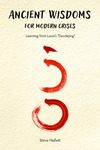
Ancient Wisdoms for Modern Crises: Learning From Laozi’s “Daodejing”
Steve Hallett
We live in a time of abundance and comfort for some, scarcity and hardship for others—a period that seems to have all of us teetering on the brink. Certainly, there is no lack of modern crises, but do we possess the wisdom to overcome them, and where might we seek that wisdom? Ancient Wisdoms for Modern Crises: Learning From Laozi’s “Daodejing[JR1] [ED2] [NN3] ” looks to the Daodejing, a text written during the late Zhou Dynasty (600–400 BCE), for guidance. One of the core treatises of Eastern philosophy, it advocates humility, simplicity, and sustainable living. As both a personal and political philosophy, it is radically gentle, encouraging readers to embrace humility, modesty, compassion, and selflessness while simultaneously resisting the urge to conquer, control, and dominate—teachings that can help each of us navigate contemporary life. Finding solutions to such difficult problems requires all the wisdom, ancient and modern, that humans can muster. Replete with the author’s fresh translation of the eighty-one-verse Daodejing, this book touches on topics ranging from environmentalism and human suffering to biodiversity loss and the rise of authoritarianism in an effort to forge a more restrained, sustainable, just, supportive, and compassionate society.
-
A Passion for Ideas: How Innovators Create the New and Shape Our World
Heinrich V. Pierer and Bolko V. Oetinger
Business and industry leaders are eager to find ways to spark the creative instinct in their work forces. This newly translated work examines the multi-layered environment of innovation by melding the thoughts of business management pundits like Peter Senge with the views of artist, politicians, and other non-traditional thinkers like Tao Ho, Peter Greenaway, and Wolfgang Rihm.
-
Applied Ethics in Animal Research: Philosophy, Regulation, and Laboratory Applications
John P. Gluck, Tony DiPasquale, and F. Barbara Orlans
This volume is a collection of chapters all contributed by individuals who have presented their ideas at conferences and who take moderate stands with the use of animals in research. Specifically the chapters bear of the issues of: notions of the moral standings of animals, history of the methods of argumentation, knowledge of the animal mind, nature and value of regulatory structures, how respect for animals can be converted from theory to action in the laboratory. The chapters have been tempered by open discussion with individuals with different opinions and not audiences of true believers. It is the hope of all, that careful consideration of the positions in these chapters will leave reader with a deepened understanding, not necessarily a hardened position.
-
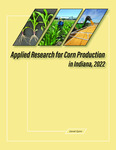
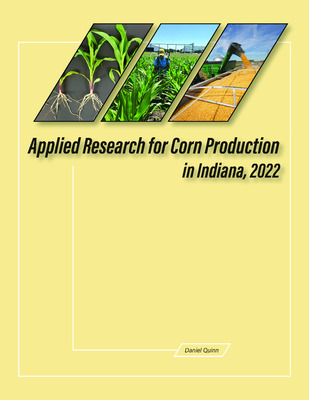
Applied Research for Corn Production in Indiana, 2022
Daniel Quinn
The 2022 edition of Applied Research for Corn Production in Indiana offers accessible, research-based tips for farmers who want to improve corn production practices by using applied field-research trials. Daniel Quinn and the Purdue University Corn Agronomy team reveal practical ways to boost yields, reduce costs, and improve sustainability on the farm. Their findings are derived from applied research trials across the state and relate to important topics such as planting practices, fertilizer use, crop nutrition, cover crops, and new technologies. Applied Research for Corn Production in Indiana distills complex research into clear insights and supplies corn producers with effective methods to enhance farm efficiency and productivity.
-
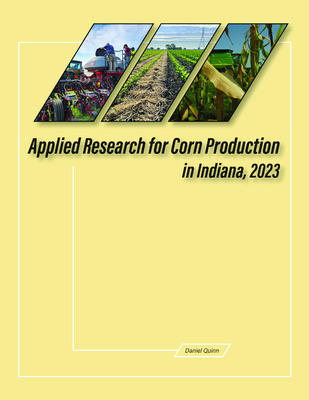
Applied Research for Corn Production in Indiana, 2023
Daniel Quinn
The 2023 edition of Applied Research for Corn Production in Indiana offers accessible, research-based tips for farmers who want to improve corn production practices by using applied field-research trials. Daniel Quinn and the Purdue University Corn Agronomy team reveal practical ways to boost yields, reduce costs, and improve sustainability on the farm. Their findings are derived from applied research trials across the state and relate to important topics such as planting practices, fertilizer use, crop nutrition, cover crops, and new technologies. Applied Research for Corn Production in Indiana distills complex research into clear insights and supplies corn producers with effective methods to enhance farm efficiency and productivity.
-
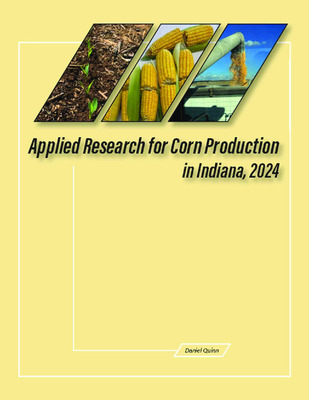
Applied Research for Corn Production in Indiana, 2024
Daniel Quinn
The 2024 edition of Applied Research for Corn Production in Indiana offers accessible, research-based tips for farmers who want to improve corn production practices by using applied field-research trials. Daniel Quinn and the Purdue University Corn Agronomy team reveal practical ways to boost yields, reduce costs, and improve sustainability on the farm. Their findings are derived from applied research trials across the state and relate to important topics such as planting practices, fertilizer use, crop nutrition, cover crops, and new technologies. Applied Research for Corn Production in Indiana distills complex research into clear insights and supplies corn producers with effective methods to enhance farm efficiency and productivity.
-

Applied Research in Field Crop Pathology for Indiana, 2019
Darcy E. P. Telenko
Applied Research in Field Crop Pathology for Indiana, 2019 serves as a summary of the applied field crop pathology research trials conducted in 2019 under the direction of the Purdue Field Crop Pathology program in the Department of Botany and Plant Pathology at Purdue University. In Indiana, there are more than 57,600 farms, 16,000 crop producers, and 900 certified crop advisers, Extension educators, and crop-protection industry representatives who manage more than 11.4 million crop-production acres with a total value of $6.3 billion annually. There are more than twenty diseases affecting corn, soybeans, and wheat that may decrease crop production and profitability. In a single growing season in the state, diseases can cause a total estimated loss of more than $400 million, making disease identification and management a primary concern. The goal of this book is to share some of the most current, nonbiased, research-based information to address the management of field crop diseases. This data will support individuals engaged in crop production, helping them select effective, sustainable, and economically sound disease-management practices to implement on their farms.
-
Applied Research in Field Crop Pathology for Indiana, 2020
Darcy E. P. Telenko
Applied Research in Field Crop Pathology for Indiana, 2020 serves as a summary of the applied field crop pathology research trials conducted in 2020 under the direction of the Purdue Field Crop Pathology program in the Department of Botany and Plant Pathology at Purdue University. In Indiana, there are more than 57,600 farms, 16,000 crop producers, and 900 certified crop advisers, Extension educators, and crop-protection industry representatives who manage more than 11.4 million crop-production acres with a total value of $6.3 billion annually. There are more than twenty diseases affecting corn, soybeans, and wheat that may decrease crop production and profitability. In a single growing season in the state, diseases can cause a total estimated loss of more than $400 million, making disease identification and management a primary concern. The goal of this book is to share some of the most current, nonbiased, research-based information to address the management of field crop diseases. This data will support individuals engaged in crop production, helping them select effective, sustainable, and economically sound disease-management practices to implement on their farms.
-
Applied Research in Field Crop Pathology for Indiana, 2021
Darcy E. P. Telenko and Sujoung Shim
Applied Research in Field Crop Pathology for Indiana, 2021 serves as a summary of the applied field crop pathology research trials conducted in 2021 under the direction of the Purdue Field Crop Pathology program in the Department of Botany and Plant Pathology at Purdue University. In Indiana, there are more than 57,600 farms, 16,000 crop producers, and 900 certified crop advisers, Extension educators, and crop-protection industry representatives who manage more than 11.4 million crop-production acres with a total value of $6.3 billion annually. There are more than twenty diseases affecting corn, soybeans, and wheat that may decrease crop production and profitability. In a single growing season in the state, diseases can cause a total estimated loss of more than $400 million, making disease identification and management a primary concern. The goal of this book is to share some of the most current, nonbiased, research-based information to address the management of field crop diseases. This data will support individuals engaged in crop production, helping them select effective, sustainable, and economically sound disease-management practices to implement on their farms.
-
Applied Research in Field Crop Pathology for Indiana, 2022
Darcy E. P. Telenko and Sujoung Shim
Applied Research in Field Crop Pathology for Indiana, 2022 serves as a summary of the applied field crop pathology research trials conducted in 2022 under the direction of the Purdue Field Crop Pathology program in the Department of Botany and Plant Pathology at Purdue University. In Indiana, there are more than 57,600 farms, 16,000 crop producers, and 900 certified crop advisers, Extension educators, and crop-protection industry representatives who manage more than 11.4 million crop-production acres with a total value of $6.3 billion annually. There are more than twenty diseases affecting corn, soybeans, and wheat that may decrease crop production and profitability. In a single growing season in the state, diseases can cause a total estimated loss of more than $400 million, making disease identification and management a primary concern. The goal of this book is to share some of the most current, nonbiased, research-based information to address the management of field crop diseases. This data will support individuals engaged in crop production, helping them select effective, sustainable, and economically sound disease-management practices to implement on their farms.
-
Applied Research in Field Crop Pathology for Indiana, 2023
Darcy E. P. Telenko and Sujoung Shim
Applied Research in Field Crop Pathology for Indiana, 2023 serves as a summary of the applied field crop pathology research trials conducted in 2023 under the direction of the Purdue Field Crop Pathology program in the Department of Botany and Plant Pathology at Purdue University. In Indiana, there are more than 57,600 farms, 16,000 crop producers, and 900 certified crop advisers, Extension educators, and crop-protection industry representatives who manage more than 11.4 million crop-production acres with a total value of $6.3 billion annually. There are more than twenty diseases affecting corn, soybeans, and wheat that may decrease crop production and profitability. In a single growing season in the state, diseases can cause a total estimated loss of more than $400 million, making disease identification and management a primary concern. The goal of this book is to share some of the most current, nonbiased, research-based information to address the management of field crop diseases. This data will support individuals engaged in crop production, helping them select effective, sustainable, and economically sound disease-management practices to implement on their farms.
-
Applied Research in Field Crop Pathology for Indiana, 2024
Darcy E. P. Telenko and Sujoung Shim
Applied Research in Field Crop Pathology for Indiana, 2024 serves as a summary of the applied field crop pathology research trials conducted in 2024 under the direction of the Purdue Field Crop Pathology program in the Department of Botany and Plant Pathology at Purdue University. In Indiana, there are more than 57,600 farms, 16,000 crop producers, and 900 certified crop advisers, Extension educators, and crop-protection industry representatives who manage more than 11.4 million crop-production acres with a total value of $6.3 billion annually. There are more than twenty diseases affecting corn, soybeans, and wheat that may decrease crop production and profitability. In a single growing season in the state, diseases can cause a total estimated loss of more than $400 million, making disease identification and management a primary concern. The goal of this book is to share some of the most current, nonbiased, research-based information to address the management of field crop diseases. This data will support individuals engaged in crop production, helping them select effective, sustainable, and economically sound disease-management practices to implement on their farms.
-

Aquaponics: Farming Fish and Growing Greens for Grades 9–12
Amy M. Shambach,; Rebecca M. Ward; J. Stuart Carlton; Kwamena K. Quagrainie; and Tomas O. Höök
Aquaponics: Farming Fish and Growing Greens for Grades 9–12 teaches STEM-related course material through aquaponics, a water-based agricultural system that combines aquaculture (fish production) and hydroponics (soilless vegetable production) systems. This curriculum is aligned with Next Generation Science Standards and designed to be used with an onsite aquaponics system. Topics include an introduction to aquaculture, fundamental parts of an aquaponics system, the nitrogen cycle, water quality, population dynamics, our modern food system, and more. The ten lessons presented build on each other and are intended to be delivered in sequential order. Alternatively, lessons may also be utilized as stand-alone units to supplement other curricular activities.
-

A Story for All Americans: Vietnam, Victims, and Veterans
Frank L. Grzyb and John F. Kerry
Story for All Americans: Vietnam, Victims, and Veterans (formerly titled, Touched by the Dragon) details wartime accounts of average servicemen and women-some heroic, some frightening, some amusing, some nearly unbelievable. The work is a historical compendium of fascinating and compelling stories woven together in a theme format. What makes this book truly unique, however, is its absence of literary pretentiousness. Relating oral accounts, the veterans speak in a no-nonsense, matter-of-fact way. As seen through the eyes of the veterans, the stories include first-person experiences of infantry soldiers, a flight officer, a medic, a nurse, a combat engineer, an intelligence soldier, and various support personnel. Personalities emerge gradually as the veterans discuss their pre war days, their training and preparation for Vietnam, and their actual in-country experiences. The stories speak of fear and survival: the paranoia of not knowing who or where the enemy was; the bullets, rockets, and mortars that could mangle a body or snuff out a life in an instant; and going home with a CMH - not the Congressional Medal of Honor, but a Casket with Metal Handles. The veterans also speak of friendships and simple acts of kindness. But more importantly, they speak of healing-both physically and mentally.
-

A Summer of Mass Murder: 1941 Rehearsal for the Hungarian Holocaust
George Eisen
Most accounts of the Holocaust focus on trainloads of prisoners speeding toward Auschwitz, with its chimneys belching smoke and flames, in the summer of 1944. This book provides a hitherto untold chapter of the Holocaust by exploring a prequel to the gas chambers: the face-to-face mass murder of Jews in Galicia by bullets.
The summer of 1941 ushered in a chain of events that had no precedent in the rapidly unfolding history of World War II and the Holocaust. In six weeks, more than twenty thousand Hungarian Jews were forcefully deported to Galicia and summarily executed. In exploring the fate of these Hungarian Jews and their local coreligionists, A Summer of Mass Murder transcends conventional history by introducing a multitude of layers of politics, culture, and, above all, psychology—for both the victims and the executioners.
The narrative presents an uncharted territory in Holocaust scholarship with extensive archival research, interviews, and corresponding literature across countries and languages, incorporating many previously unexplored documents and testimonies. Eisen reflects upon the voices of the victims, the images of the perpetrators, whose motivation for murder remains inexplicable. In addition, the author incorporates the long-forgotten testimonies of bystander contemporaries, who unwittingly became part of the unfolding nightmare and recorded the horror in simple words.
This book also serves as a personal journey of discovery. Among the twenty thousand people killed was the tale of two brothers, the author’s uncles. In retracing their final fate and how they were swept up in the looming genocide, A Summer of Mass Murder also gives voice to their story.
-
(A)wry Views: Anamorphosis, Cervantes, and the Early Picaresque
David R. Castillo
The term anamorphosis, from the greek ana (again) and morphe (shape), designates a variety of perspective experiments that can be traced back to the artistic developments of the 1500's and 1600's. Anamorphic devices challenge viewers to experience different forms of perceptual oscillation and uncertainty. Images shift in front of the eyes of puzzled spectators as they move from the center of the representation to the margins, or from one side to the other. (A) Wry Views demonstrates that much of the literature of the Spanish Golden Age is susceptible, and indeed requires, oblique readings (as in anamorphosis).
-

Bell Telephone System’s Preeminent Role in the Growth of Industrial Design
Ralph O. Meyer and Russell A. Flinchum
Histories of design pay scant attention to the corded telephone, which played an immeasurable role in early communication. Although the Bell System, with many Nobel Prizes, is justly acknowledged for its technical prowess, it should also be recognized for its early and considerable impact on the developing discipline of industrial design. In 1930, young Henry Dreyfuss, who would later become known as a pioneer of industrial design, was retained by the Bell System as a design consultant and matured in that environment. With substantial input from Bell System engineers, Dreyfuss and his staff produced attractive telephone designs that were manufactured and installed in more than one hundred million American homes and copied around the world. Featuring over one hundred illustrations, Bell Telephone System’s Preeminent Role in the Growth of Industrial Design is a deep dive into the development and evolution of the corded telephone. A detailed case study of an object that would become so ubiquitous and commonplace, it is also the story writ large of the establishment and importance of the field of industrial design.
-

Building Your Epic Life: Your Journey, Your Way, Your Masterpiece
Luciano Castillo
Building Your Epic Life empowers young people to understand that failure is an inevitable—and essential—part of the journey to success. The author shares his own challenges and struggles, showing that no path to success is linear and without setbacks. The book teaches the value of building a healthy body, mind, and spirit, and includes exercises that offer actionable plans for individuals to realize a meaningful, self-defined life based on their core values. A proven roadmap workbook and short lectures guide readers through a series of practical steps to discover their purpose, vision, and understand the value of mentorship—and why each of these is fundamental in identifying life’s important moments and opportunities. Building Your Epic Life also recommends a range of books, affirmations, and daily routines for students and professionals who want to reach their full potential.