
Files
Download Full Text (8.7 MB)
Page Count
82
Language
English
Description
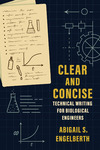
Clear and Concise: Technical Writing for Biological Engineers is a practical guide designed to help students and early career engineers communicate their work with clarity and confidence. Drawing on years of teaching experience, Abigail S. Engelberth breaks down the essentials of technical writing into approachable steps, showing readers how to organize ideas, present data effectively, and write reports that meet professional standards.
Rather than overwhelming readers with theory, the book focuses on real-world application. It includes examples, checklists, and strategies for common engineering documents including formal and memo-style lab reports. Special attention is given to visuals, formatting, and the role of collaboration and peer review in producing strong technical documents.
Clear and Concise offers a student-centered approach, concentrating on what students struggle with most and the feedback they find most useful. Whether writing your first lab report or preparing for industry, this guide will help readers articulate their ideas clearly, avoid common pitfalls, and build a skill set that will serve them throughout their careers.
ISBN
9781626713208
Publication Date
Winter 2-15-2026
Publisher
Purdue University Press
City
West Lafayette
Keywords
writing skills for STEM students, formatting references and attribution, strategies for writing in teams, designing figures, tables, and equations, bioseparations lab procedures, instructor feedback objectives, documenting experiments for reproducibility, explaining data trends, skills for engineering students, developing templates, visual aids, KISS principle, avoiding jargon, active vs. passive verbs, understanding audience and tone, usage of past tense, scientific notation, artificial intelligence and technical writing, organizing supplemental materials
Disciplines
Engineering
Recommended Citation
Engelberth, Abigail S., "Clear and Concise: Technical Writing for Biological Engineers" (2026). Purdue University Press Books. 104.
https://docs.lib.purdue.edu/purduepress_ebooks/104
Comments
Open access publication of this title is supported by Purdue University Libraries and School of Information Studies.