

Purdue University Press provides quality resources in several key subject areas, including business, technology, health, veterinary sciences, and other selected disciplines in the humanities and sciences. As well as publishing around 25 books a year, and three subscription-based journals, the Press is committed to broadening access to scholarly information using digital technology. As part of this initiative, the Press distributes a number of Open Access electronic-only journals.
This series contains the Open Access records of some books published through Purdue University Press.














































-

To The Other: An Introduction to the Philosophy of Emmanuel Levinas
Adriaan Peperzak
Note About the Online Edition
Nearly two decades ago, To the Other: An Introduction to the Philosophy of Emmanuel Levinas was published, and as its title declared, its purpose was to introduce the reader into the major themes of Levinas’s work. Through a combination of close readings and primary texts and translations, the author hoped to provide a set of conceptual keys that would assist new readers in orienting themselves to Levinas’s difficult writings.
Since its publication, interest in Levinas has grown exponentially: many important studies have been written, and Levinas’s influence has extended to a variety of different fields and questions of philosophy and the human sciences. The secondary literature has matured and become more sophisticated; it now presupposes a reader with some familiarity with the major concepts and concerns with which Levinas wrestled.
It would be impossible today, therefore, to write an introduction for today’s readers of Levinas without taking account of the vast body of literature that has explored Levinas’s work in the past two decades, while relating them carefully back to Levinas’s texts. The modest revision of the first chapter in the online edition presented here was not intended to accomplish that task. It was intended rather to amend some of the defects of the original work. Although it does not address itself to the rich developments of Levinas scholarship, it might still function as an introduction through its close reading of Levinas’s programmatic essay, which contains the main lines of Totality and Infinity, and its elucidation of relations to Plato, Heidegger, and some other luminaries of the philosophical tradition.
The rest of the online version is identical to the 1993 edition published by Purdue University Press (ISBN 978-1-55753-024-0). Because it was necessary to typeset the new first chapter to correspond with the original publication, index entries referring to the first 37 pages of the book may not be accurate.
Adriaan Peperzak, University of Chicago
October 2010
-
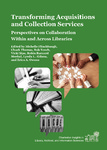
Transforming Acquisitions and Collection Services
Michelle Flinchbaugh, Chuck Thomas, Rob Tench, Vicki Sipe, Robin Barnard Moskal, Lynda L. Aldana, and Erica A. Owusu
This book explores ways in which libraries can reach new levels of service, quality, and efficiency while minimizing cost by collaborating in acquisitions. In consortial acquisitions, a number of libraries work together, usually in an existing library consortia, to leverage size to support acquisitions in each individual library. In cross-functional acquisitions, acquisitions collaborates to support other library functions. For the library acquisitions manager, technical services manager, or the library director, awareness of different options for effective consortial and cross-functional acquisitions allows for the optimization of staff and resources to reach goals. This work presents those options in the form of case studies, as well as useful analysis of the benefits and challenges of each.
By supporting each other’s acquisitions services in a consortium, libraries leverage size to get better prices, and share systems and expertise to maximize resources while minimizing costs. Within libraries, the library acquisitions function can be combined with other library functions in a unit with more than one purpose, or acquisitions can develop a close working relationship with another unit to support their work. This book surveys practice at different libraries and at different library consortia, and presents a detailed description and analysis of a variety of practices for how acquisitions units support each other within a consortium, and how they work with other library units, specifically collection management, cataloging, interlibrary loan, and the digital repository, in the form of case studies. A final sections of the book covers fundamentals of collaboration.
-

Transforming Institutions: Undergraduate STEM Education for the 21st Century
Gabriela C. Weaver, Wilella D. Burgess, Amy L. Childress, and Linda Slakey
Higher education is coming under increasing scrutiny, both publically and within academia, with respect to its ability to appropriately prepare students for the careers that will make them competitive in the 21st-century workplace. At the same time, there is a growing awareness that many global issues will require creative and critical thinking deeply rooted in the technical STEM (science, technology, engineering, and mathematics) disciplines. However, the existing and ingrained structures of higher education, particularly in the STEM fields, are not set up to provide students with extensive skill development in communication, teamwork, and divergent thinking, which is needed for success in the knowledge economy.
In 2011 and again in 2014, an international conference was convened to bring together university leaders, educational policymakers and researchers, and funding agency representatives to discuss the issue of institutional transformation in higher education, particularly in the STEM disciplines. Central to the issue of institutional transformation is the ability to provide new forms of instruction so that students can gain the variety of skills and depth of knowledge they will need. However, radically altering approaches to instruction sets in motion a domino effect that touches on learning space design, instructional technology, faculty training and reward structures, course scheduling, and funding models. In order for one piece to move, there must be coordinated movement in the others, all of which are part of an entrenched and interconnected system.
Transforming Institutions brings together chapters from the scholars and leaders who were part of the 2011 and 2014 conferences. It provides an overview of the context and challenges in STEM higher education, contributed chapters describing programs and research in this area, and a reflection and summary of the lessons from the many authors’ viewpoints, leading to suggested next steps in the path toward transformation.
-
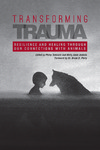
Transforming Trauma: Resilience and Healing Through Our Connections With Animals
Philip Tedeschi and Molly Anne Jenkins
Have you ever looked deep into the eyes of an animal and felt entirely known? Often, the connections we share with non-human animals represent our safest and most reliable relationships, offering unique and profound opportunities for healing in periods of hardship. This book focuses on research developments, models, and practical applications of human-animal connection and animal-assisted intervention for diverse populations who have experienced trauma. Physiological and psychological trauma are explored across three broad and interconnected domains: 1) child maltreatment and family violence; 2) acute and post-traumatic stress, including military service, war, and developmental trauma; and 3) times of crisis, such as the ever-increasing occurrence of natural disasters, community violence, terrorism, and anticipated or actual grief and loss. Contributing authors, who include international experts in the fields of trauma and human-animal connection, examine how our relationships with animals can help build resiliency and foster healing to transform trauma. A myriad of animal species and roles, including companion, therapy, and service animals are discussed. Authors also consider how animals are included in a variety of formal and informal models of trauma recovery across the human lifespan, with special attention paid to canine- and equine-assisted interventions and psychotherapy. In addition, authors emphasize the potential impacts to animals who provide trauma-informed services, and discuss how we can respect their participation and implement best practices and ethical standards to ensure their well-being. The reader is offered a comprehensive understanding of the history of research in this field, as well as the latest advancements and areas in need of further or refined investigation. Likewise, authors explore, in depth, emerging practices and methodologies for helping people and communities thrive in the face of traumatic events and their long-term impacts. As animals are important in cultures all over the world, cross-cultural and often overlooked animal-assisted and animal welfare applications are also highlighted throughout the text.
-
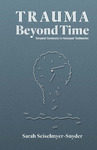
Trauma Beyond Time: Temporal Constructs in Holocaust Testimonies
Sarah Seiselmyer-Snyder
Trauma Beyond Time: Temporal Constructs in Holocaust Testimonies challenges our understanding of what it means to be a Holocaust survivor, arguing that the term “post-Holocaust” fundamentally misrepresents survivors’ experiences. Through careful analysis of Holocaust literature and testimony, this book reveals how trauma persists across generations, defying conventional historical timelines. For those who perished, there can be no “after” to the Holocaust—their stories were violently ended. Yet for survivors, the Holocaust didn’t simply conclude in 1945. Their experiences demonstrate how trauma continues to shape lives decades later, making “post-Holocaust” a misleading concept that fails to capture their ongoing reality. Using the multigenerational testimony of the Tabak family as a case study, this research shows how trauma disrupts linear time, creating a continuous present where past horrors remain alive. The author examines Holocaust diaries that end abruptly with their authors’ deaths, alongside memoirs that document how survivors navigate a world forever altered by their experiences. Perhaps most profound is the examination of intergenerational trauma, where descendants inherit the psychological imprint of events they never personally witnessed. For these individuals, there is no “before” the Holocaust—only its ongoing echoes through family memory and inherited trauma. By reconsidering how we frame survivorship, this book calls for a more nuanced, trauma-informed approach to Holocaust studies that honors the continuing reality of survivors’ experiences.
-

Turfgrass Weed Control for Professionals, 2024
Aaron J. Patton and Matthew T. Elmore
Turfgrass is used on everything from athletic fields, golf courses, and parks, to lawns, sod farms, and roadsides. Unfortunately, information on weed management for professionals maintaining these areas has often been inaccurate or out of date, and applicators are frequently unaware of the most effective methods for controlling weeds in turf. Written by experts in the field and featuring insights from contributors from sixteen states across the US, the 2024 edition of Turfgrass Weed Control for Professionals was developed to provide science-based information for those working in the field. It contains information about turfgrass management, weed biology and management, more than 350 photographs to assist in the identification of a variety of weeds, information on how herbicides work, research-based information on the efficacy of herbicides on target weeds, the use of plant-growth regulators, and other useful tips for those managing turfgrasses. First published in 2012 and annually updated to include the most current information, Turfgrass Weed Control for Professionals has long served as a valuable guide for applicators looking to improve weed control, improve integrated weed management, and reduce maintenance costs for their businesses.
-

Understanding the Global Energy Crisis
Eugene D. Coyle and Richard A. Simmons
We are facing a global energy crisis caused by world population growth, an escalating increase in demand, and continued dependence on fossil-based fuels for generation. It is widely accepted that increases in greenhouse gas concentration levels, if not reversed, will result in major changes to world climate with consequential effects on our society and economy. This is just the kind of intractable problem that Purdue University’s Global Policy Research Institute seeks to address in the Purdue Studies in Public Policy series by promoting the engagement between policy makers and experts in fields such as engineering and technology.
Major steps forward in the development and use of technology are required. In order to achieve solutions of the required scale and magnitude within a limited timeline, it is essential that engineers be not only technologically-adept but also aware of the wider social and political issues that policy-makers face. Likewise, it is also imperative that policy makers liaise closely with the academic community in order to realize advances. This book is designed to bridge the gap between these two groups, with a particular emphasis on educating the socially-conscious engineers and technologists of the future.
In this accessibly-written volume, central issues in global energy are discussed through interdisciplinary dialogue between experts from both North America and Europe. The first section provides an overview of the nature of the global energy crisis approached from historical, political, and sociocultural perspectives. In the second section, expert contributors outline the technology and policy issues facing the development of major conventional and renewable energy sources. The third and final section explores policy and technology challenges and opportunities in the distribution and consumption of energy, in sectors such as transportation and the built environment. The book’s epilogue suggests some future scenarios in energy distribution and use.
-

Universities in Imperial Austria, 1848–1918: A Social History of a Multilingual Space
Jan University Surman
Combining history of science and a history of universities with the new imperial history, Universities in Imperial Austria 1848–1918: A Social History of a Multilingual Space by Jan Surman analyzes the practice of scholarly migration and its lasting influence on the intellectual output in the Austrian part of the Habsburg Empire.
The Habsburg Empire and its successor states were home to developments that shaped Central Europe's scholarship well into the twentieth century. Universities became centers of both state- and nation-building, as well as of confessional resistance, placing scholars if not in conflict, then certainly at odds with the neutral international orientation of academe.
By going beyond national narratives, Surman reveals the Empire as a state with institutions divided by language but united by legislation, practices, and other influences. Such an approach allows readers a better view to how scholars turned gradually away from state-centric discourse to form distinct language communities after 1867; these influences affected scholarship, and by examining the scholarly record, Surman tracks the turn.
Drawing on archives in Austria, the Czech Republic, Poland, and Ukraine, Surman analyzes the careers of several thousand scholars from the faculties of philosophy and medicine of a number of Habsburg universities, thus covering various moments in the history of the Empire for the widest view. Universities in Imperial Austria 1848–1918 focuses on the tension between the political and linguistic spaces scholars occupied and shows that this tension did not lead to a gradual dissolution of the monarchy’s academia, but rather to an ongoing development of new strategies to cope with the cultural and linguistic multitude.
-
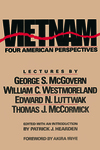
Vietnam, Four American Perspectives: Lectures
George S. McGovern, William C. Westmoreland, Edward N. Luttwak, Thomas J. McCormick, and Patrick F. Hearden
This collection of speeches delivered in 1987 presents the widely diverging opinions of four men: an eminent politician, a professional soldier, a government consultant, and a distinguished scholar. The first contributor, Senator George S. McGovern, ran as the Democratic candidate for president in 1972 on a platform that called for the withdrawal of American troops from Vietnam. The second speaker, General William C. Westmoreland, commanded American military forces in Vietnam until growing battlefield casualties and economic costs undermined support for the strategy of attrition in the United States. The third essay is by Edward N. Luttwak, a strong advocate for military reform in the United States and a frequent participant in high-level government discussions about American strategic interests throughout the world. The fourth speaker Thomas J. McCormack, is a diplomatic historian at the University of Wisconsin and an astute critic of American foreign policy. Each lecture is followed by a lively question-and-answer session that highlights the key points of agreement and disagreement with respect to the fundamental issues raised in the lectures. In a stimulating foreword, Akira Iriye challenges readers to think about the Vietnam War in relationship to the current debate about the role that the United States should play in world affairs.
-
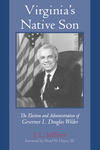
Virginia's Native Son: The Election and Administration of Governor L. Douglas Wilder
J. L. Jeffries
In Virginia's Native Son, the election of L. Douglas Wilder in Virginia represents the first time an African-American was elected Governor in the history of the United States. The book hits on five main points of his election and administration, including an analysis of the campaign victory, the media's response to the campaign, the racism involved with the election and administration, the administration itself, and the legacy of the administration.
-
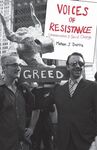
Voices of Resistance: Communication and Social Change
Mohan J. Dutta
This book re-presents voices of resistance from across the globe to document the communicative processes, practices, and frameworks through which neoliberal global policies are currently being defied. Based on examples, case studies, and ethnographic reports, Voices of Resistance serves as a space for engaging various perspectives from the global margins in dialogue. The emphasis of the book is on the core idea that creating spaces for listening to voices of resistance fosters openings for the politics of social change; interweaving the stories of the local, the national, and the global. The book is divided into chapters addressing the politics of resistance in the contexts of global economic policies, agriculture, education, health, poverty, and development.
Mohan J. Dutta is Professor of Communication and Director of Center on Poverty and Health Inequities (COPHI) at Purdue University.
-
Wake Up Your Call Center: Humanizing Your Interaction Hub
Rosanne D’Ausilio
D'Ausilio, an industrial psychologist, uses humor to encourage customer service representatives in call centers, their immediate superiors, middle and upper management, and team leaders, seniors, and supervisors. She offers simple tips on staying sane in the call center environment and on raising quality.
-
Weather and Climate Science Education for Grades 3–12
Natalie J. Carroll, Theodore Leuenberger, and Gretchen Leuenberger
What’s the weather today? People are interested in the weather so they can plan their day, determine what they should wear, if they should venture outside, when and where to vacation, and many other tasks. Gardeners and farmers need to understand both weather and climate to decide what and where to plant, and how best to take care of their animals. Homeowners also need to understand typical climate conditions, allowing them to determine which flowers and shrubs to plant on their properties. It also tells them what kind of insulation, furnace, and air conditioner to install. And when stormy weather is predicted, people need to be prepared. It is important that they know how to be safe in dangerous weather.
The first level of Weather and Climate Science Education for Grades 3–12 introduces basic weather words and ideas. These activities focus on understanding the weather around you. Readers will also begin to learn the difference between weather and climate, and how these ideas are related. The second level introduces readers to more complex weather topics. They will learn about air pressure, winds, humidity, and fronts. The third level delves more deeply into weather and climate science. This level will help prepare readers to understand weather all through their lifetimes. The final section, the Facilitator’s Guide, provides answers to the youth activities as well as information about Next Generation Science Standards.
-
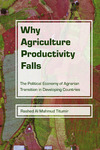
Why Agriculture Productivity Falls: The Political Economy of Agrarian Transition in Developing Countries
Rashed Al Mahmud Titumir
Why Agriculture Productivity Falls: The Political Economy of Agrarian Transition in Developing Countries offers a new explanation for the decline in agricultural productivity in developing countries. Transcending the conventional approaches to understanding productivity using agricultural inputs and factors of production, this work brings in the role of formal and informal institutions that govern transactions, property rights, and accumulation. This more robust methodology leads to a comprehensive, well-balanced lens to perceive agrarian transition in developing countries. It argues that the existing process of accumulation has resulted in nonsustainable agriculture because of market failures—the result of asymmetries of power, diseconomies of scale, and unstable property rights. The book covers the historical shifts in land relations, productivity, and class relations that have led to present-day challenges in sustainability. The result is arrested productivity growth. Agrarian transition should be understood in the context of the wider economic development in society, including how political settlement and primitive accumulation inhibited the kind of property rights that encourage growth. Why Agriculture Productivity Falls is a much-needed corrective to the traditional understanding, because before we can increase productivity, we must understand the root causes of those challenges.
-
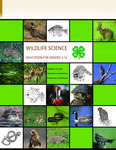
Wildlife Science Education for Grades 3–12
Natalie J. Carroll, Theodore Leuenberger, and Katherine Leuenberger
Wildlife Science Education for Grades 3–12 guides and encourages youth to learn about the wildlife around them. The first section introduces the basic wildlife groups to youth in upper elementary school using hands-on and other activity-based learning techniques. Young learners will understand the similarities and differences between mammals, birds, fish, and herptiles. The activities for middle schoolers expand the study to interactions within and between them. The lessons for high school students are based on topics of importance to homeowners, residents of a watershed, food and fiber producers (farmers), mayors, teachers, and policy makers. This section delves deeper into the study of wildlife and will help prepare students to study these topics at the college or university level. This final section is intended for adults who work with youth. It includes suggestions about instructing youth, next-generation science standards, and answers to questions asked in sections 1–3.
-

Women Count: A Guide to Changing the World
Susan Bulkeley Butler and Bob Keefe
Throughout history, women have struggled to change the workplace, change government, change society. So what’s next? It’s time for women to change the world! Whether on the job, in politics, or in their community, there has never been a better time for women to make a difference in the world, contends author, mentor, and corporate pioneer Susan Bulkeley Butler in Women Count: A Guide to Changing the World. Through her experience as the first female partner of a major consulting firm and founder of the Susan Bulkeley Butler Institute for the Development of Women Leaders, Butler’s unique insights have changed the lives of countless women. In Women Count, she shows readers how to change the world through a series of inspiring case studies that chronicle how she and other pioneering women in a range of fields have done so in years past. Women represent half of the country’s population, half of the country’s college graduates, and around 50 percent of the country’s workforce. Butler envisions a day when they will also make up their fair share of elected and appointed positions, including in corporate boardrooms. Amid financial meltdowns, wars, and societal struggles, never before has the world so greatly needed the unique abilities of women to lead the way. But as history has shown, to make change, women must step into their power and become “women who count,” Butler contends. Then and only then, she argues, can women truly change the world.
-
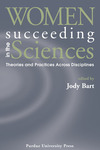
Women Succeeding in the Sciences: Theories and Practices Across Disciplines
Jody Bart
Ample evidence has been provided that women historically have suffered numerous social, political, and institutional barriers to their entrance and success in the sciences. The articles in this anthology refocus the discussion and reflect the interdisciplinary nature of the issues surrounding women in the sciences. While the barriers that women have faced as researchers, subjects of research, students of science, and theorists have been well documented, this anthology breaks new ground. It presents the ways women succeed in the sciences, overcome these historical barriers, and contribute to the social practice of science and the philosophy of science in both theory and practice.